
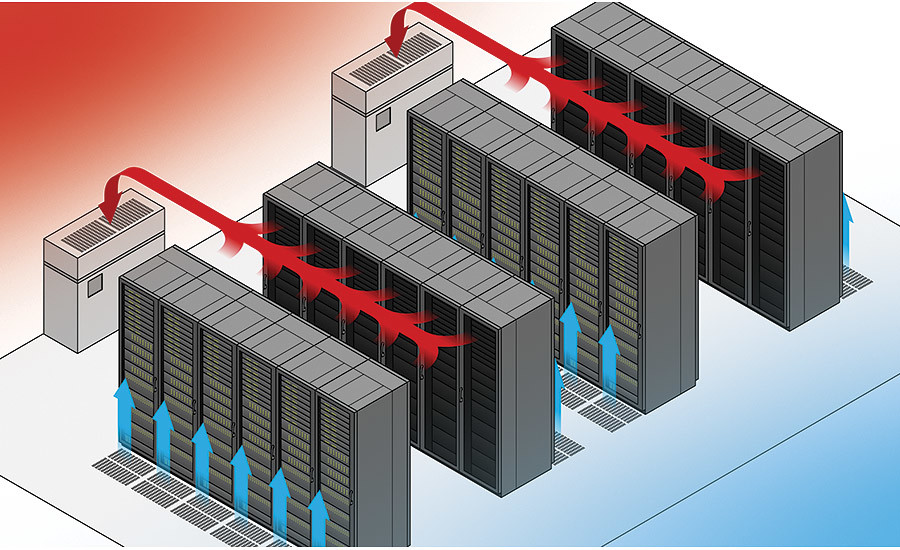
The rapid expansion of artificial intelligence infrastructure is driving a new era of growth for the HVAC industry, as data center operators invest heavily in advanced cooling technologies capable of supporting increasingly dense computing environments. Industry analysts describe the current market environment as one of the most significant opportunities for commercial cooling providers in recent decades.
Across major global markets, developers are constructing new facilities at an unprecedented pace to meet demand for cloud computing, machine learning, and high-performance processing applications.
While computing capacity often receives the most attention, thermal management has emerged as one of the industry’s most critical engineering challenges.
Modern AI workloads generate enormous amounts of heat.
As server densities continue to increase, traditional cooling strategies are being pushed to their limits. Data center operators now require highly specialized HVAC systems capable of maintaining precise environmental conditions while minimizing energy consumption.
Industry experts note that cooling infrastructure can account for a substantial portion of total facility energy usage.
As a result, operators are aggressively pursuing technologies that improve thermal efficiency and reduce operating costs.
Liquid cooling systems have received considerable attention in recent years.
Unlike traditional air-based approaches, liquid cooling can remove heat more efficiently from high-density computing equipment. Although adoption remains at varying stages across different markets, many analysts expect liquid cooling deployments to expand significantly as AI-related workloads continue to grow.
However, air-based HVAC systems remain a foundational component of most facilities.
Advanced computer room air handlers, precision cooling units, containment systems, and intelligent airflow management solutions continue to play essential roles in maintaining operational stability.
Manufacturers report increasing demand for systems capable of delivering higher cooling capacities while supporting sophisticated monitoring and control capabilities.
The geographic distribution of new data center projects is also influencing HVAC requirements.
Developers are expanding into regions with varying climate conditions, creating demand for customized cooling strategies that balance performance, efficiency, and sustainability objectives.
In warmer climates, cooling infrastructure often represents one of the largest operational cost categories.
This reality has encouraged innovation in areas such as economization, heat recovery, advanced controls, and hybrid cooling architectures.
Sustainability considerations are becoming increasingly important as well.
Many technology companies have established ambitious environmental targets, placing pressure on facility operators to reduce energy usage and carbon emissions.
Consequently, HVAC suppliers capable of delivering measurable efficiency improvements are attracting substantial interest.
Industry participants report that data center projects increasingly evaluate cooling systems not only on initial capital cost but also on long-term energy performance and operational flexibility.
This shift favors technologies that can adapt to changing workload requirements over the lifespan of the facility.
The talent shortage affecting both the HVAC and data center sectors presents another challenge.
Highly specialized cooling systems require skilled engineers, designers, installers, and maintenance personnel.
As project pipelines continue to expand, competition for experienced professionals is intensifying throughout the industry.
Manufacturers are responding through increased investment in training programs, technical support resources, and digital tools designed to simplify deployment and maintenance activities.
Supply chain resilience remains another area of focus.
Given the scale of ongoing data center construction activity, stakeholders are prioritizing supplier relationships capable of supporting large projects while minimizing procurement risks.
Looking ahead, industry observers expect cooling technologies to remain at the center of data center innovation.
The continued growth of AI applications, cloud services, and digital infrastructure is likely to sustain strong demand for advanced HVAC solutions for years to come.
For HVAC manufacturers, contractors, and service providers, the data center market represents more than a short-term opportunity. It reflects a structural shift in global infrastructure investment that is placing thermal management at the heart of the digital economy.
As computational demands continue to rise, the ability to deliver reliable, efficient, and scalable cooling solutions will increasingly determine the success of next-generation data center developments worldwide.