
On a Tuesday afternoon in the middle of August, an air conditioning unit fails. The family inside is immediately aware. The temperature climbs quickly. The HVAC company that answers the phone is booking emergency slots three days out. The technician who eventually arrives diagnoses a failed compressor — the most expensive single component in the system. A part that, on inspection, had been showing early warning signs for weeks.
This scenario plays out thousands of times every summer across the country. For homeowners, it is expensive, stressful, and entirely avoidable. For HVAC companies, emergency calls are time-intensive, logistically disruptive, and increasingly difficult to staff given the current technician shortage. For everyone involved, the timing is the worst possible: peak season, maximum heat, minimum equipment availability, maximum urgency.
Predictive HVAC maintenance is a technology-driven approach to eliminating exactly this scenario. And in 2026, it has moved decisively from commercial building application into mainstream residential availability.
The Three Ages of HVAC Maintenance
To understand why predictive maintenance matters, it helps to understand the two approaches it is replacing.
Reactive maintenance is the oldest model. Something breaks, you call for repair. This is the most expensive and most disruptive approach. Emergency service calls carry labor premiums. Delays are common, especially in peak season. By the time a failure is obvious, the damage has often extended beyond the original faulty component — a seized bearing damages the motor shaft; a refrigerant leak, allowed to run long enough, stresses the compressor. The “wait until it breaks” model consistently produces the highest repair bills.
Preventive maintenance was the improvement. Scheduled service visits — typically twice a year, in fall and spring — give a technician the opportunity to inspect equipment, clean coils, check refrigerant charge, and identify obvious wear before it produces a failure. It is genuinely effective and is meaningfully better than reactive-only maintenance. Its limitation is that it provides a snapshot in time. A part can be in perfect condition on the day of the inspection and fail three weeks later. Calendar-based maintenance cannot see developing faults between visits.
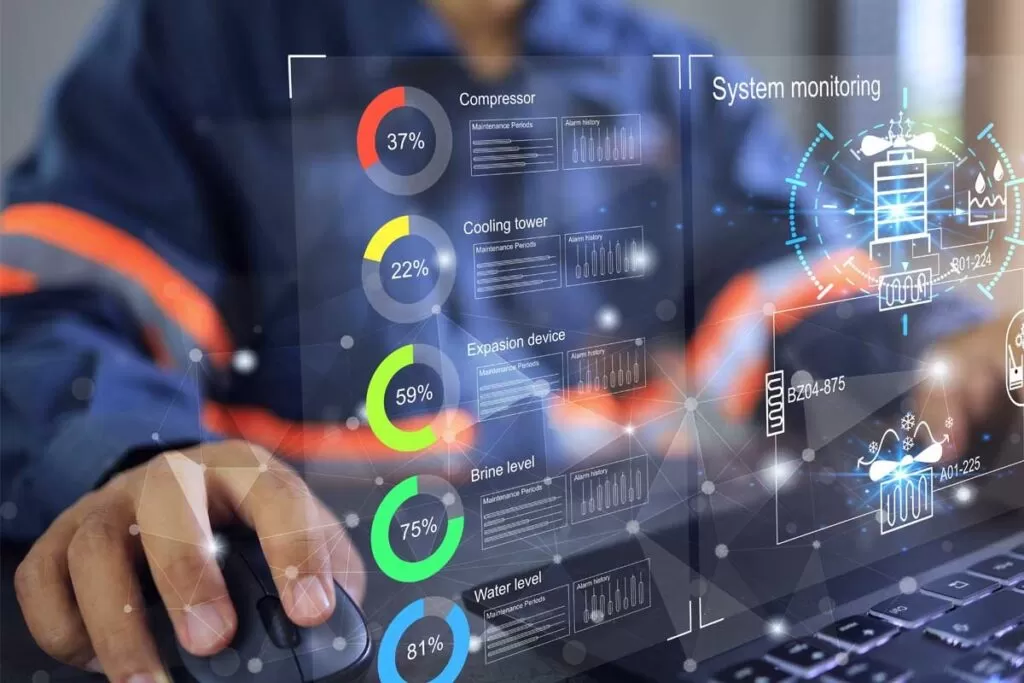
Predictive maintenance is the third stage, and it addresses the fundamental gap of the other two: instead of waiting for a failure or relying on periodic snapshots, it provides continuous monitoring. IoT sensors installed on HVAC components collect data in real time — temperature, pressure, current draw, vibration, refrigerant levels, airflow — and feed that data into AI algorithms that establish performance baselines and detect deviations that indicate developing faults, often weeks before they produce a visible symptom or a complete breakdown.
The result is a system that can, in a meaningful sense, tell you when it is starting to feel unwell.
What the Technology Actually Measures
The power of predictive maintenance comes from combining multiple data streams that, individually, might look like noise, but collectively signal a meaningful pattern. This is the key distinction between simple sensor monitoring and genuine AI-driven prediction.
A chiller or residential system approaching a compressor fault doesn’t trigger a single obvious alarm. Instead, it produces subtle correlated changes across multiple readings: compressor current draw climbs slightly, suction pressure drifts, superheat value shifts, condenser leaving temperature edges upward. Individually, each variation looks like normal operational variability. Taken together across days and weeks, they constitute a fault signature that AI systems trained on large failure datasets recognize as a precursor to compressor failure — weeks before the compressor actually fails.
The sensors doing this work measure several key parameters:
Electrical current draw. One of the most diagnostic measurements available. Current signature analysis can detect bearing wear, valve degradation, and refrigerant issues three to six weeks before failure. A compressor that’s beginning to struggle draws more current than a healthy one under the same conditions. A motor bearing approaching failure creates characteristic current fluctuations. These signals are invisible to a technician during an annual inspection but visible to continuous monitoring systems.
Vibration. Vibration sensors catch mechanical degradation in fan motors, compressors, and bearings. Abnormal vibration patterns appear weeks before the mechanical failure they signal becomes audible or visible. Combined with current analysis, vibration and current together predict 70 to 85 percent of compressor failures.
Temperature differentials. The temperature difference between supply air and return air — called “delta-T” — tells the system how effectively the unit is transferring heat. A delta-T that is gradually shrinking over days and weeks indicates declining performance: a dirty coil fouling slowly, refrigerant charge declining, or airflow restriction developing. This kind of drift is undetectable without continuous measurement, but highly actionable once identified.
Refrigerant pressure. Wireless pressure sensors on suction and discharge lines detect charge loss, restrictions, and compressor valve issues, calculating superheat and subcooling in real time without a technician needing to connect gauges. Refrigerant monitoring systems can detect leaks as small as 0.5 ounces per year — important not only for performance, but for compliance with the EPA’s tightening HFC management requirements under the AIM Act.
According to facility management research, 85 percent of HVAC system failures resulting in full shutdown show measurable precursor signals in sensor data seven to 21 days before the failure event actually occurs. That window is the operational value of predictive maintenance — it converts emergency repairs into scheduled interventions.
What Predictive Maintenance Saves
The financial case is well-documented across both commercial and residential applications.
According to the U.S. Department of Energy, predictive maintenance programs save 8 to 12 percent over preventive maintenance approaches and up to 30 to 40 percent compared to reactive strategies. For a homeowner spending $800 to $1,200 a year on heating and cooling costs, the efficiency gains from continuous optimization add up meaningfully. An HVAC system that is struggling with a dirty coil or a failing motor can use up to 40 percent more electricity than a healthy unit — costs that are invisible until the utility bill arrives.
Beyond energy savings, the equipment lifespan case is compelling. By preventing the strain caused by faulty components, predictive maintenance can extend the life of an HVAC system by 20 to 30 percent. On a system that costs $8,000 to $15,000 to replace, an additional three to five years of service life represents a significant return on the monitoring investment.
On the repair cost side, properties using AI-powered HVAC monitoring have reduced operating costs by over 33%, while predictive maintenance has saved property owners between $20,000 and $40,000 in equipment replacement costs over a five-year period. Emergency repair premiums — the 50 to 100 percent surcharges that commonly apply to after-hours and peak-season calls — are substantially reduced when developing faults are caught and scheduled before they become emergencies.
A real-world residential case study illustrates the potential vividly. A mid-sized HVAC company in Minnesota — Genz-Ryan — tested a predictive maintenance platform across approximately 350 customer homes as part of a pilot program. Sensors were installed on HVAC equipment to feed data to the cloud, and the contractor’s team received alerts about any anomalies. The results were striking: the system identified over 95 percent of potential failures before they became critical, and homeowners experienced zero unexpected downtime during the entire year-long trial. The company’s president described the program as a “game-changer,” noting that proactive warnings eliminated emergencies entirely for participating customers.
How Residential Systems Are Deployed
Predictive maintenance technology originated in commercial building management, where the scale of investment in large chillers and air handling units justified dedicated sensor networks and facility management software. In 2026, consumer-scale versions of this technology have arrived at accessible price points for residential homeowners.
The simplest entry point is a smart thermostat with diagnostic capabilities. Modern AI thermostats monitor run times, temperature differentials, and cycle patterns, and flag anomalies that suggest developing performance problems. This level of monitoring — essentially built into a $200 to $300 device — provides a meaningful first layer of predictive visibility.
A more comprehensive setup adds dedicated IoT sensors to major components: current sensors on the compressor and blower motor, temperature sensors at supply and return air, and pressure transducers on refrigerant lines. These sensors communicate wirelessly to a gateway device that transmits data to cloud analytics platforms. Modern wireless IoT sensors install without cabling on existing equipment in hours, making retrofit applications straightforward for any occupied home.
Many HVAC service companies now offer monitoring packages that combine professional sensor installation with ongoing analytics and alert services. These typically operate on a subscription model — $15 to $50 per month — providing continuous monitoring with direct alerts sent to both the homeowner and the service contractor when anomalies are detected. For homeowners who want enterprise-level monitoring without managing the technology themselves, this model is the most accessible path.
The economics of residential predictive monitoring have improved dramatically. Several insurance companies now offer “sensor subsidies” or reduced premium rates for homes with active HVAC monitoring, recognizing that the frequency of major home system claims is lower in monitored homes. The $500 sensor investment can pay off not just through avoided repair costs but through direct insurance benefits.
What Happens When the System Detects a Problem
The alert workflow is worth understanding, because it illustrates what makes predictive maintenance practically different from simply owning a smart thermostat.
When an AI monitoring system detects an anomaly — a current signature suggesting bearing wear, a delta-T trend indicating coil fouling, a pressure pattern consistent with developing refrigerant loss — it generates an alert with three key pieces of information: what component is showing abnormal behavior, what the likely fault mechanism is, and how urgent the intervention appears to be based on the rate of deterioration.
In a professionally managed monitoring program, this alert goes simultaneously to the homeowner and the service contractor. The contractor can review the sensor data, confirm the diagnosis remotely, and dispatch a technician with the right parts already on the truck — eliminating the diagnostic visit, the parts-ordering delay, and the second visit that currently characterize most HVAC repair processes.
The entire interaction shifts from reactive to proactive: you are calling your contractor before the problem is visible, during a time window of your choosing, for a scheduled appointment at normal service rates.
What Predictive Maintenance Cannot Do
It’s worth being clear about the limits of the technology.
Predictive maintenance does not eliminate the need for periodic professional service visits. Regulatory-required maintenance tasks — filter changes, coil cleaning, drain line treatment, combustion analysis on gas equipment — still require scheduled visits. What predictive maintenance eliminates is the unnecessary time-based visits that happen because they’re on the calendar when nothing is actually wrong, and the emergency events that happen between visits when something developing was invisible.
Not all fault types are catchable weeks in advance. Some failure modes — a capacitor that fails suddenly under electrical stress, a refrigerant line that is physically damaged — produce no meaningful precursor signal. Predictive maintenance dramatically reduces the frequency of surprise failures, but does not eliminate them entirely.
And the quality of prediction depends on the quality and quantity of sensor data. A system with a single temperature sensor will miss fault signatures that require current analysis or vibration data. The more complete the sensor setup, the higher the prediction accuracy — and the higher the upfront installation cost.
The Broader Shift
The trajectory of predictive HVAC maintenance mirrors what happened in other domains where continuous monitoring replaced periodic inspection. Cars now have continuous diagnostics. Modern aircraft are instrumented in ways that were unimaginable thirty years ago. Home HVAC systems are undergoing the same transformation, driven by sensors that have dropped in cost dramatically, AI models trained on millions of equipment data points, and smartphone connectivity that makes the outputs accessible to any homeowner.
The “call us when it breaks” model of HVAC maintenance is not yet extinct. But it is becoming obsolete. Predictive monitoring replaces the anxiety of a breakdown that might happen at any moment with continuous, data-grounded visibility into the actual condition of your system. It catches the 85 percent of failures that announce themselves weeks in advance and converts them from emergency events into planned service calls.
Your HVAC system can now tell you when it needs help. In 2026, the only question is whether you’re listening.
Ask your HVAC contractor about predictive monitoring packages for your home’s system, or search for NATE-certified contractors offering smart maintenance programs in your area at natex.org.