
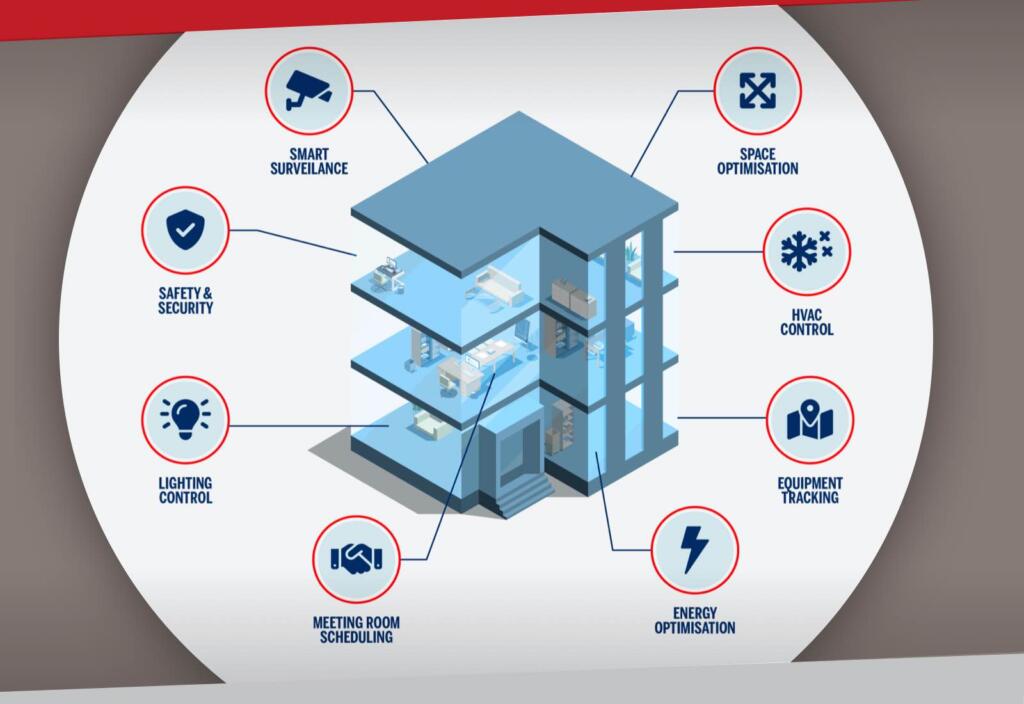
The adoption of smart-building technologies is reshaping HVAC operations across commercial facilities worldwide, as organizations increasingly leverage real-time data, automation, and analytics to improve efficiency and operational performance.
Industry experts describe the trend as a fundamental shift away from reactive facility management toward continuous optimization driven by connected systems and intelligent controls.
At the center of this transformation lies the HVAC infrastructure that serves as one of the largest energy-consuming systems in most commercial buildings.
Building owners are investing heavily in technologies capable of improving visibility into system performance while reducing operating costs and environmental impact.
Modern smart-building platforms collect data from thousands of connected devices distributed throughout a facility.
Temperature sensors, occupancy monitors, airflow measurement devices, humidity sensors, energy meters, and equipment controllers generate continuous streams of operational information.
This data is then analyzed through centralized management platforms that provide facility teams with detailed insights into building performance.
Unlike traditional building automation systems that primarily focused on scheduling and basic control functions, newer platforms incorporate advanced analytics capable of identifying inefficiencies and recommending corrective actions.
For example, systems can detect simultaneous heating and cooling events, identify poorly performing equipment, or uncover occupancy patterns that allow ventilation schedules to be optimized.
Facility managers report that one of the greatest benefits of smart-building technology is improved decision-making.
Rather than relying on periodic inspections or occupant complaints, operators can monitor conditions continuously and respond to issues before they escalate.
The financial implications are significant.
Energy expenditures remain one of the largest operating costs for many commercial properties. Even modest improvements in HVAC efficiency can generate substantial savings over the lifespan of a building.
As electricity prices continue to rise in numerous markets, organizations are placing greater emphasis on technologies that deliver measurable reductions in energy consumption.
Smart controls are proving particularly effective in this area.
Systems can automatically adjust temperature setpoints, ventilation rates, and equipment operating schedules based on real-time occupancy levels and environmental conditions.
This dynamic approach helps minimize waste while maintaining occupant comfort.
Sustainability objectives are further accelerating adoption.
Many organizations have established carbon-reduction targets that require ongoing improvements in building performance. Smart HVAC technologies provide a practical pathway toward achieving these goals through continuous optimization and performance monitoring.
The integration of artificial intelligence is adding another layer of capability.
Machine-learning algorithms can analyze historical operating data to identify patterns and predict future requirements. As a result, HVAC systems can increasingly anticipate demand rather than simply react to changing conditions.
Manufacturers are adapting accordingly.
Equipment suppliers are introducing products with embedded connectivity, cloud integration, and advanced diagnostic capabilities. Many new systems are designed specifically to operate within broader smart-building ecosystems.
Cybersecurity remains an important consideration as connectivity expands.
Industry stakeholders emphasize the importance of secure architectures, software updates, access controls, and data protection measures to safeguard critical building infrastructure.
Despite implementation challenges, market momentum continues to build.
Industry analysts expect smart-building investment to remain a major growth driver for the HVAC sector throughout the coming decade.
As technologies mature and return-on-investment calculations become increasingly favorable, connected HVAC systems are likely to become standard components of modern commercial facilities.
For building owners, the transition represents an opportunity to improve efficiency, reduce costs, enhance occupant experiences, and strengthen sustainability performance simultaneously.
For the HVAC industry, it signals a future in which data and intelligence become as important as mechanical equipment itself.