
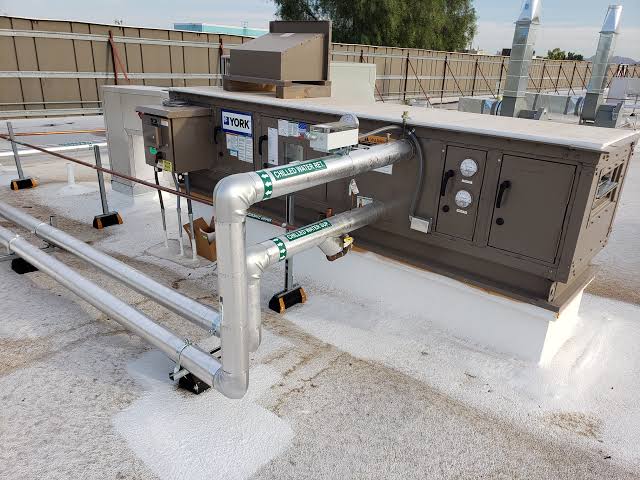
Commercial property owners are increasing investment in HVAC retrofit projects as rising energy costs and sustainability initiatives drive demand for higher-performing building systems.
Across office buildings, retail centers, healthcare facilities, educational institutions, and mixed-use developments, aging HVAC infrastructure is becoming a primary focus of modernization efforts.
Industry consultants report that energy expenditures remain one of the largest operating expenses for many commercial properties. Consequently, building owners are increasingly evaluating HVAC upgrades as a means of improving financial performance while supporting environmental objectives.
Many retrofit projects involve replacing equipment that has exceeded its optimal service life.
Legacy systems often operate at significantly lower efficiency levels than modern alternatives, resulting in higher utility costs and increased maintenance requirements.
The economic case for modernization has strengthened in recent years as advances in equipment technology deliver greater performance improvements than previous upgrade cycles.
Variable-speed compressors, intelligent controls, energy-recovery systems, and high-efficiency heat exchangers are enabling substantial reductions in energy consumption across a wide range of applications.
Building owners are increasingly taking a whole-system approach to retrofits.
Rather than replacing individual components, many projects incorporate controls upgrades, ventilation improvements, sensor networks, and building automation enhancements designed to maximize overall performance.
Industry experts note that data-driven decision-making is playing an increasingly important role in retrofit planning.
Energy audits, performance benchmarking, and continuous monitoring tools help organizations identify inefficiencies and prioritize investments with the strongest return potential.
Financial incentives are also contributing to market activity.
Many utility providers and government programs offer rebates, grants, or financing support for qualifying energy-efficiency projects, helping reduce upfront investment requirements.
Tenant expectations represent another important driver.
Occupants increasingly value comfortable, energy-efficient environments equipped with modern building systems. Property owners view HVAC upgrades as a means of improving tenant satisfaction and strengthening asset competitiveness.
Sustainability commitments continue to influence purchasing decisions as well.
Organizations pursuing carbon-reduction goals frequently identify HVAC modernization as one of the most impactful opportunities for lowering building emissions.
Industry forecasts suggest retrofit activity will remain a significant growth area throughout the remainder of the decade.
As commercial properties seek to balance operational efficiency, occupant comfort, and environmental performance, HVAC modernization is expected to remain a central component of long-term building investment strategies.
For contractors, equipment manufacturers, and service providers, the growing retrofit market presents substantial opportunities as organizations continue transforming aging facilities into higher-performing assets.