
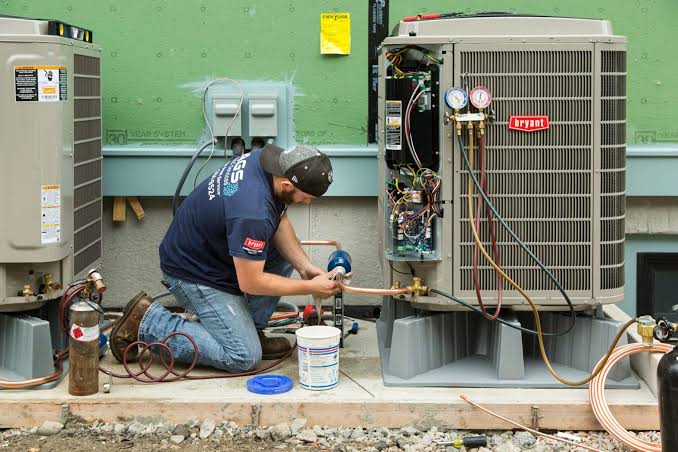
If you’ve recently called an HVAC technician, gotten a quote for a new air conditioner, or even just glanced at a spec sheet on a new heat pump, you’ve probably encountered an unfamiliar term: R-454B. Maybe the contractor mentioned it in passing. Maybe you noticed it on a manufacturer’s website and felt a flicker of confusion, followed by the vague sense that something had changed without anyone bothering to tell you.
Something did change. And it’s bigger than most homeowners realize.
As of January 1, 2026, the HVAC industry has formally transitioned away from R-410A — the refrigerant that has cooled the majority of American homes for the past two decades — and shifted to a new generation of lower-emission alternatives, primarily R-454B and R-32. The mandate comes from the EPA’s Technology Transitions Program under the American Innovation and Manufacturing (AIM) Act, which requires new residential HVAC systems to use refrigerants with a Global Warming Potential (GWP) of 700 or less. R-410A, with a GWP of 2,088, comfortably fails that standard.
The good news for most homeowners is that this transition is far less disruptive than the internet might suggest. The bad news is that understanding what it means for your existing system, your next purchase, and your repair costs requires wading through a fair amount of misinformation. This article cuts through the noise.
Why Refrigerants Matter — And Why This One Had to Go
To understand why R-410A is being phased out, it helps to understand what refrigerants do and why their environmental properties matter at all.
A refrigerant is the working fluid inside your air conditioner or heat pump. It cycles between liquid and gas states to absorb heat from inside your home and release it outside, which is how cooling (and in the case of heat pumps, heating) actually works. The refrigerant never gets used up in normal operation; it just cycles continuously.
The problem arises when refrigerant escapes. Leaks happen — at fittings, in coils, during service calls where proper recovery procedures aren’t followed. When high-GWP refrigerants escape into the atmosphere, they trap heat far more effectively than carbon dioxide. R-410A has a GWP of 2,088, meaning that one pound of R-410A released into the atmosphere has roughly 2,088 times the warming effect of one pound of CO2 over a 100-year period.
This isn’t a new concern. The industry has gone through this before. Older refrigerants like R-22 were phased out starting in 2010 and completed in 2020 because they damaged the ozone layer. R-410A was developed specifically to solve that problem — and it did. But R-410A turned out to be a potent contributor to climate change, which is what now drives the current transition.
The newest refrigerants are designed to fix both problems simultaneously. R-454B has a GWP of approximately 466 — a reduction of roughly 78 percent compared to R-410A. R-32, the other primary alternative, has a GWP of 675. Both are ozone-safe and climate-friendly relative to what they replace. Both are also mildly flammable, a classification that has significant implications for how they’re handled — and for what’s built into the systems that use them.
What This Means If You’re Buying New Equipment in 2026
If you’re shopping for a new central air conditioner, heat pump, or mini-split system in 2026, the refrigerant decision has already been made for you. Every new residential system rolling off manufacturer production lines uses R-454B or R-32. R-410A equipment is no longer being manufactured for residential applications.
The performance of these new systems is comparable to the R-410A equipment it replaces. In fact, because manufacturers took the opportunity to redesign systems from the ground up for the new refrigerants — incorporating newer compressor technology and improved heat exchanger designs in the process — new R-454B systems generally achieve higher SEER2 efficiency ratings than the R-410A equipment at equivalent price points.
SEER2 is itself worth a brief explanation. The Department of Energy introduced updated efficiency ratings labeled SEER2 to better reflect how systems perform under real-world operating conditions, which include a wider range of temperatures and pressures than the older SEER ratings. When comparing new systems, SEER2 is the current standard.
For new equipment buyers, the practical outcome is straightforward: you’re getting a system that is more energy efficient and significantly lower in environmental impact than what it replaces. The refrigerant running inside it is different from what you’re used to, but from the perspective of your home’s comfort, you won’t notice.
There is one important difference in how A2L refrigerants like R-454B are handled. Because they carry a mild flammability classification under ASHRAE Standard 34, new systems built around them include integrated safety features that weren’t required with R-410A. Specifically, updated building codes now require leak detection sensors in indoor units. These sensors continuously monitor for refrigerant in the living space. If a leak is detected, the system shuts down automatically and triggers an alert. The equipment is, in other words, designed with its own safety classification explicitly in mind.
To put the flammability concern in proper context: R-454B has a very low burning velocity, meaning that even if ignited, a flame spreads slowly. Gasoline, brake fluid, and common household cleaning products are all significantly more flammable. The A2L classification is a professional handling designation, not a warning that your air conditioner poses a fire risk.
What This Means If You Already Have an R-410A System
This is where most of the confusion lives, and the answer is cleaner than much of the coverage suggests: if your R-410A system is working, you don’t need to do anything.
The 2026 refrigerant transition applies to the manufacture and installation of new equipment. It does not make your existing system illegal. It does not require replacement. R-410A refrigerant remains available to service existing equipment, and the EPA has not set any end-of-service date for R-410A systems. You can legally run, repair, and recharge your current air conditioner for the remainder of its natural lifespan — which, for a well-maintained central air system, is typically 15 to 20 years.
What is changing is the cost of maintaining older systems, and this is where homeowners with aging R-410A equipment need to pay attention.
R-410A was once abundant and relatively inexpensive. The AIM Act deliberately shrinks the allowable production volume of high-GWP refrigerants on a fixed schedule each year. As production allowances decrease while the installed base of millions of R-410A systems continues to need service, basic supply-and-demand economics drive prices upward. At the wholesale level, R-410A has roughly doubled in price over the past couple of years, climbing from around $6 to $10 per pound to approximately $12 to $18 per pound by early 2026. Industry projections suggest this trend continues: a refrigerant recharge that cost $400 in 2023 may cost $650 to $700 or more by 2027.
For a newer R-410A system in good condition — say, five to eight years old with no significant issues — this cost trajectory doesn’t create urgency to replace. The system has years of useful life remaining, and even rising refrigerant costs are manageable in the context of a well-functioning unit.
For older R-410A systems — approaching ten years or more, with a history of repairs or known issues — the calculus is different. When a major component fails (a compressor replacement, for instance, can run $1,500 to $2,500 or more), the combination of that repair cost, rising refrigerant prices, and declining system efficiency begins to compete seriously with the cost of a new system that comes with higher efficiency ratings, current refrigerant, and a fresh warranty.
The One Thing You Cannot Do: Retrofit
A question that comes up frequently: can an existing R-410A system simply be converted to use R-454B or R-32?
The answer is no, and this is important to understand. New refrigerants are designed for equipment specifically built around their properties — including different operating pressures, safety requirements, and component materials. Existing R-410A systems cannot be retrofitted to use A2L refrigerants. If you’re replacing your system, you’re getting new R-454B equipment from the ground up. If you’re keeping your existing system, it stays on R-410A for its remaining life.
There are no workarounds here, and homeowners should be skeptical of any contractor suggesting otherwise.
Federal Tax Credits and Rebates: The Financial Upside
One development that works strongly in favor of homeowners considering a new system is the current federal incentive landscape. Under the Inflation Reduction Act, qualifying high-efficiency HVAC systems are eligible for substantial tax credits and rebates that can meaningfully offset the upfront cost of new equipment.
Heat pumps qualifying under the Energy Efficient Home Improvement Credit are eligible for up to $2,000 in federal tax credits. Central air conditioning units that meet the efficiency threshold are eligible for up to $600. Some homeowners may also qualify for upfront rebates through utility-run programs or state-level energy initiatives, in addition to the federal tax credits.
For a homeowner in the repair-versus-replace decision on an older R-410A system, these incentives can shift the economics considerably. A new heat pump system that might cost $8,000 to $12,000 installed, with a $2,000 federal tax credit plus potential utility rebates, represents a meaningfully different financial proposition than the sticker price alone suggests.
It’s worth consulting with a tax professional about how these credits apply to your specific situation, since eligibility depends on efficiency ratings, income thresholds, and other factors that vary by circumstance.
What to Ask Your HVAC Contractor
The refrigerant transition has created a period of genuine transition in the trades as well. Technicians working on A2L systems require updated safety certifications — specialized training in handling mildly flammable refrigerants, proper brazing techniques, leak testing, and charge verification. Not every contractor in the country has completed this training yet.
When hiring an HVAC contractor for new installation or for service on an older system, there are several straightforward questions worth asking:
Are your technicians A2L-certified? For any new installation in 2026, this is a baseline requirement. A contractor installing new R-454B equipment without current A2L certification is operating outside industry safety standards.
How are you sourcing R-410A for existing system service? A reputable contractor will have a supply chain for existing systems and won’t pressure you to replace a functioning unit solely on refrigerant grounds.
What SEER2 ratings are available at my budget? Efficiency standards have risen significantly. Understanding where the systems you’re being quoted fall on the efficiency spectrum — and how that affects long-term operating costs — helps you make a better-informed decision.
What warranty coverage comes with new equipment? Most new R-454B systems from major manufacturers (Carrier, Lennox, Trane, and others) come with competitive warranty terms. Confirm both equipment warranty and installation labor warranty.
The Bottom Line
The refrigerant transition of 2026 is real, significant, and environmentally meaningful. R-454B and R-32 represent a genuine improvement in the industry’s climate footprint, and the equipment designed around them is more efficient than what it replaces.
For most homeowners, the practical impact is more limited. If your system is running well, nothing changes today. The refrigerant decision has been made for you when the time does come to replace it — every new system on the market already uses one of the approved alternatives.
If you’re in the market for new equipment now, you’re buying into systems that have been tested and refined across millions of installations in Europe and Asia, where many countries completed the same transition years ago. The technology is not experimental. It is mainstream.
And if you’re somewhere in between — an aging system that’s starting to show its age, staring down a meaningful repair — the combination of rising R-410A costs, improved new system efficiency, and available federal tax credits makes 2026 one of the better years in recent memory to consider an upgrade.
The refrigerant is different. The comfort it delivers is not.
Consult a licensed, A2L-certified HVAC contractor in your area to assess your current system and get current pricing on new equipment eligible for federal tax credits.